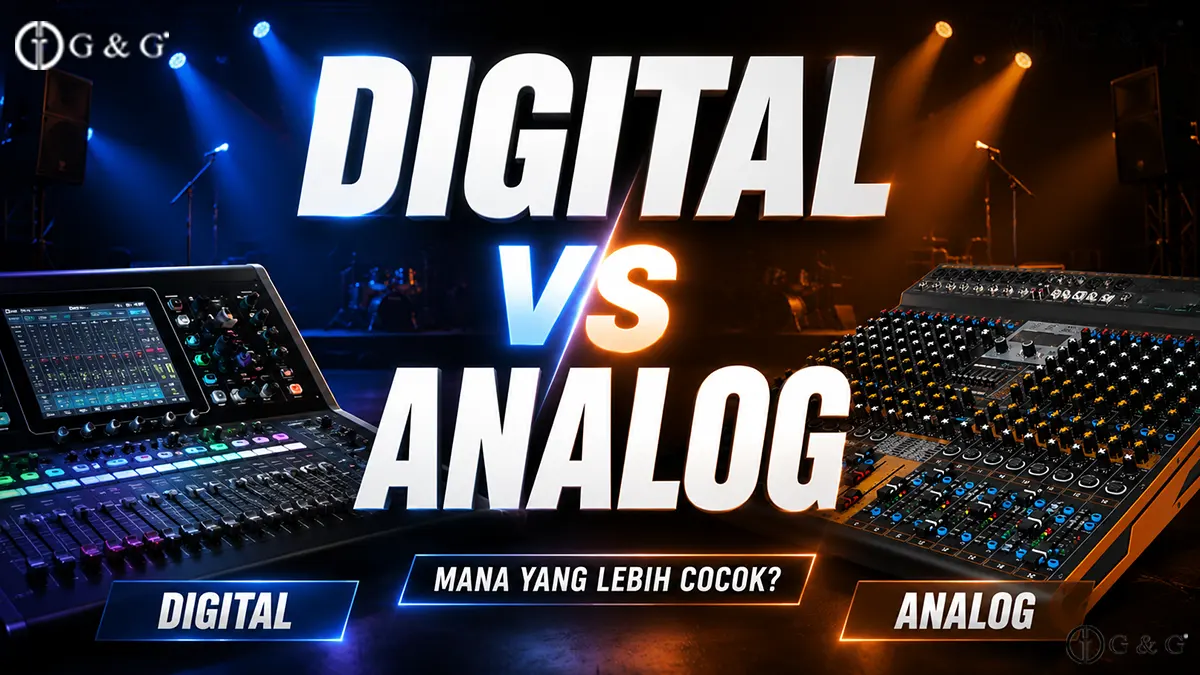
In the fast-paced world of modern events that demand high quality, the selection of audio equipment is one of the main keys to success. One of the most vital components is the mixer. However, amidst the onslaught of technology, a classic question often arises: Digital Mixer vs Analog Mixer, which one is actually more suitable for your event?
For procurement companies, government agencies, or event organizers looking for the best audio solutions, understanding the fundamental differences between these two types of mixers is crucial. The right decision will not only affect sound quality but also operational efficiency and your budget.
Table of Contents
- What is a Digital Mixer?
- What is an Analog Mixer?
- Key Feature Comparison: Digital Mixer vs Analog Mixer
- Advantages and Disadvantages of Digital Mixers
- Advantages and Disadvantages of Analog Mixers
- When to Choose a Digital Mixer?
- When to Choose an Analog Mixer?
- Mixer Recommendations for Modern Events from Digital Musik
- FAQ: Common Questions about Digital and Analog Mixers
- Conclusion: The Best Choice for Your Event
- Consultation with Digital Musik
What is a Digital Mixer?
A digital mixer is an audio mixing device that converts analog signals into digital data, processes them, and then converts them back into analog signals for output. This process allows digital mixers to offer advanced features not possible with analog mixers, such as built-in effects, automation, and remote control.
What is an Analog Mixer?
An analog mixer is a traditional audio mixing device that processes audio signals directly in the form of electrical waveforms. Every knob and fader on an analog mixer is physically connected to a circuit that manipulates the signal. Its sound characteristics are often described as "warmer" or more "organic" by some audio engineers.
Key Feature Comparison: Digital Mixer vs Analog Mixer
Let's delve deeper into the key feature comparison between Digital Mixer vs Analog Mixer:
Flexibility and Features
- Digital Mixer: Offers unparalleled flexibility. You can save and recall settings (scenes), have built-in DSP (Digital Signal Processing) effects such as reverb, delay, compressor, and graphic EQ on every channel. Many models can also be controlled via tablet or laptop.
- Analog Mixer: Less flexible. Every change must be made physically on a knob or fader. Additional effects usually require external devices (outboard gear).
Sound Quality
- Digital Mixer: Sound quality is very clear and precise, especially on high-end models. However, some audio purists argue that digital sound can sometimes feel "cold" or lack character.
- Analog Mixer: Often praised for its "warm" and "musical" sound character. Harmonic distortion naturally produced by analog circuits is sometimes considered part of its appeal.
Size and Portability
- Digital Mixer: Generally more compact and lighter for the same number of channels, as many functions are integrated internally. This is very beneficial for events requiring high mobility, such as portable sound system packages.
- Analog Mixer: Tends to be larger and heavier, especially for mixers with many channels, as each channel requires a separate physical circuit.
Price and Investment
- Digital Mixer: The initial price may seem higher, but with abundant built-in features (effects, flexible routing), you won't need to buy many external devices. This can save long-term costs.
- Analog Mixer: Initial price can be lower for basic models. However, if you need complex effects or signal processing, the cost for external devices can escalate.
Ease of Use and Learning Curve
- Digital Mixer: Has a steeper learning curve due to its menu-based and touchscreen interface. However, once accustomed, operation can be very fast and efficient.
- Analog Mixer: More intuitive for beginners because each function has its own knob or fader. What you see is what you get.

Advantages and Disadvantages of Digital Mixers
Understanding the pros and cons is an important step in choosing between Digital Mixer vs Analog Mixer.
Advantages of Digital Mixers:
- Complete Features: Effects, EQ, compressor, gate, and matrix routing are often integrated into each channel.
- Scene Storage: Able to save and recall entire mixer settings, very useful for events with multiple sessions or artists.
- Remote Control: Many models can be controlled via Wi-Fi using a tablet or smartphone, providing flexibility for the sound operator's position.
- Compact Size: More space-saving and easy to transport.
- DAW Integration: Some digital mixers can function as an audio interface for multi-track recording.
- Low Noise Floor: Generally produces a cleaner signal with a lower noise floor.
Disadvantages of Digital Mixers:
- Learning Curve: Requires more time to master all its features.
- Screen Dependency: Operation relies heavily on a touchscreen or monitor, which can be an issue if software failure occurs.
- Latency: Although minimal, there is a slight delay (latency) due to signal conversion.
- Initial Cost: Models with many channels and advanced features tend to be more expensive initially.
Advantages and Disadvantages of Analog Mixers
Advantages of Analog Mixers:
- Intuitive and Easy to Use: Each control has a single function, making direct operation easier.
- Unique Sound Character: Many prefer the "warm" and "organic" sound produced.
- High Reliability: Minimal software components, so the risk of crashes or bugs is very small.
- No Latency: Direct signal processing without delay.
- Lower Initial Cost: For basic needs, analog mixers are often more affordable.
Disadvantages of Analog Mixers:
- Less Flexible: No setting storage, every change must be manual.
- Requires External Devices: Effects and advanced processing require separate units.
- Large and Heavy Size: Less portable, especially for many channels.
- Potential Noise: Susceptible to noise and interference if cables are not well managed or components start to age.
- No Remote Control: The operator must always be in front of the mixer.

When to Choose a Digital Mixer?
A digital mixer is an ideal choice if your event:
- Is Large and Complex: Music concerts, multi-panel conferences, government events, or festivals that require many inputs, outputs, and complex routing.
- Requires High Flexibility: Events with rapid artist or session changes, where settings must be altered instantly.
- Prioritizes Consistency: For procurement that requires the same sound quality standard across various locations or events.
- Has Limited FOH (Front of House) Space: Its compact size allows placement in confined areas.
- Requires Remote Control: For operators who want to move around the venue to get the best sound perspective.
- Budget Allows for a Higher Initial Investment: With consideration for cost savings on external devices.
For large-scale outdoor events, the flexibility of a digital mixer can be very helpful in managing various sound sources and ensuring optimal audio quality. You might also be interested in reading our guide on outdoor sound systems for religious events or affordable sound system packages for outdoor celebrations and weddings.
When to Choose an Analog Mixer?
An analog mixer can be the right choice if your event:
- Is Small to Medium Scale: Community events, religious gatherings, small meetings, or permanent audio installations in places of worship.
- Requires Simplicity of Operation: For users who are not very familiar with digital technology and want direct control.
- Prioritizes a Specific Sound Character: If you are looking for a "vintage" or "warm" sound nuance.
- Has a Limited Budget for Initial Purchase: For basic needs without many effects.
- Does Not Require Many Advanced Features: If you only need to adjust volume and basic EQ.

Mixer Recommendations for Modern Events from Digital Musik
As a professional audio solution provider, Digital Musik understands that every event has unique needs. Here are some product or mixer category recommendations you can consider, both from the perspective of Digital Mixer vs Analog Mixer:
- Yamaha Digital Mixer (TF or CL Series):
Suitable for: Corporate events, medium-sized concerts, modern houses of worship. Yamaha is known for its excellent sound quality, intuitive interface, and high reliability. The TF series offers ease of use with advanced features, while the CL series is an industry standard for large-scale professional events.
- Behringer X32 Digital Mixer:
Suitable for: Live band events, sound system rentals, recording studios. The X32 is a very popular digital mixer because it offers features equivalent to high-end mixers at a more affordable price. Its routing flexibility and built-in effects are its main selling points.
- Soundcraft Analog Mixer (EPM or GB Series):
Suitable for: Community events, schools, permanent installations in halls. Soundcraft is a big name in the analog world, known for its quality preamps and clean sound. The EPM series offers simplicity and reliability, while the GB series is suitable for more serious needs with a higher number of channels.
- Allen & Heath Analog Mixer (ZED Series):
Suitable for: Small bands, DJs, project studios, small events. Allen & Heath ZED series mixers are known for their solid sound quality and good durability. An excellent choice if you are looking for a distinctive analog sound character at a competitive price.
- Complete Event Sound System Package:
Suitable for: Event organizers who need an all-in-one solution. Digital Musik provides sound system packages that include a mixer (digital or analog as needed), speakers, amplifiers, and microphones, ensuring all components work optimally together. This is a practical solution for procurement without the hassle of choosing each item individually.
To complete your audio system, don't forget to also consider the selection of the right amplifier, as we discussed in the article suitable amplifiers for high-power outdoor speakers.
FAQ: Common Questions about Digital and Analog Mixers
Is a digital mixer better than an analog mixer?
Not always. Both have advantages and disadvantages. Digital mixers excel in flexibility, features, and portability, while analog mixers are known for their ease of use and sound character. The best choice depends on the specific needs of the event and the operator's preferences.
What is the ideal budget for buying a digital or analog mixer?
Budgets vary greatly. Basic analog mixers can start from a few million rupiah. Entry-level digital mixers can start from tens of millions of rupiah, while professional models can reach hundreds of millions of rupiah. Consider the features you need and the scale of your event.
Is a digital mixer difficult for beginners to operate?
Digital mixers indeed have a steeper learning curve due to their menu-based interface. However, many modern models are designed with increasingly intuitive interfaces. With a little practice, even beginners can master them.
Can an analog mixer be used for recording?
Yes, analog mixers can be used for recording, but usually require a separate audio interface to convert analog signals to digital so they can be recorded on a computer (DAW). Some modern analog mixers have USB features for direct connection.
How to maintain a mixer to last?
Keep the mixer clean from dust, avoid liquid exposure, use a power stabilizer, and ensure good air circulation. For digital mixers, perform firmware updates regularly. For analog mixers, check connections and potentiometers routinely.
Conclusion: The Best Choice for Your Event
Choosing between Digital Mixer vs Analog Mixer is not about which is absolutely superior, but rather which is most suitable for the needs, scale, and budget of your modern event. Digital mixers offer flexibility, advanced features, and portability that are perfect for complex and dynamic events. Meanwhile, analog mixers remain a solid choice for simpler events, prioritizing ease of use, and a distinctive sound character.
As a procurement company, government agency, or event organizer, consider factors such as the number of inputs/outputs, effect requirements, mobility, and the skill level of your operators. The right investment in a mixer will ensure optimal audio quality and the smooth running of every event.
Consultation with Digital Musik
Still confused about choosing the most suitable mixer for your event or project? Don't hesitate to discuss with our expert team at Digital Musik. We are ready to provide the best recommendations according to your specifications and budget.
The Digital Musik team is ready to help with your audio needs. You can directly consult at our showroom or contact us for more information. Check Digital Musik store location here: https://maps.app.goo.gl/V4LLSpEUJ8BvCaZL9