The comparison between active speakers and passive speakers is often the main question when preparing a sound system for an event. Many people are still confused in determining the right type of speaker because their characteristics and systems are different.
What are Active Speakers and Passive Speakers?

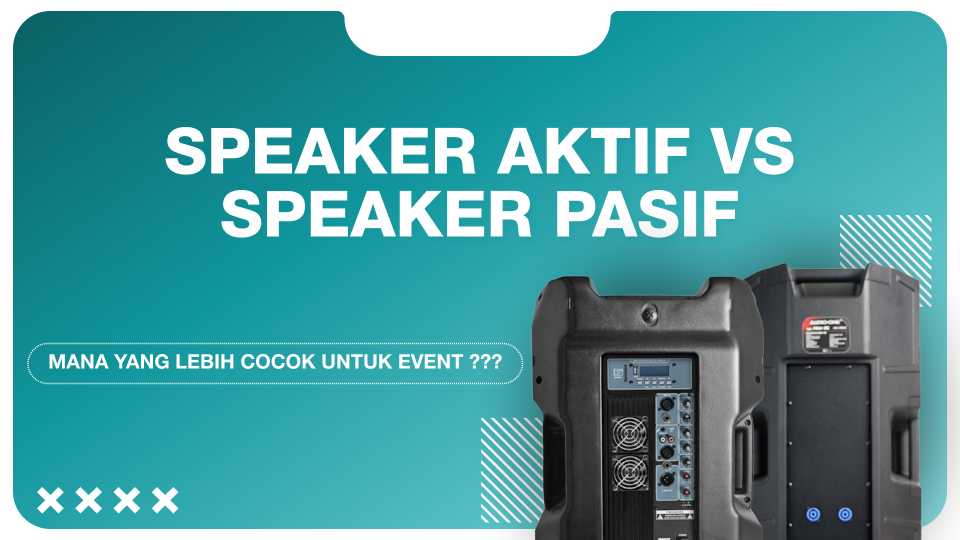
Active speakers are speakers that already have a built-in amplifier in their cabinet. On the other hand, passive speakers are speakers that require an external amplifier to produce sound.
This difference is what makes active speakers vs passive speakers have different usage characteristics for events and stages.
Active Speakers vs Passive Speakers for Small-Scale Events
For small to medium-sized events such as seminars, gatherings, and indoor weddings, active speakers are often the preferred choice.
The advantages of active speakers:
- Faster and more practical setup
- No need for additional amplifiers
- Suitable for enclosed spaces
However, active speakers have limitations if used for larger systems or expanded later.
Active Speakers vs Passive Speakers for Large-Scale Events
In large-scale events such as concerts, festivals, and outdoor stages, passive speakers are more commonly used.
The advantages of passive speakers:
- More flexible for large systems
- Easily combined with amplifiers and audio processors
- More stable for long-term use
In comparing active speakers vs passive speakers for large events, passive speakers are clearly superior in terms of control and power.
Difference between Active Speakers and Passive Speakers in Terms of Setup
Active speakers are superior in terms of ease of installation. Simply connect the sound source and power, and the speaker is ready to use.
On the other hand, passive speakers require more mature system planning because they must be adjusted with amplifiers, mixers, and other supporting devices.
The selection of active speakers vs passive speakers must be adjusted to the technical capabilities of the team and the needs of the event.
Active Speakers vs Passive Speakers in Terms of Cost
In terms of initial cost, active speakers seem more economical because they do not require additional amplifiers. However, for large systems, passive speakers are actually more efficient in the long run because they are easy to develop.
Understanding the cost difference between active speakers vs passive speakers will help you avoid purchases that do not meet your needs.
Combining Active or Passive Speakers with Subwoofers
Both active and passive speakers can be combined with subwoofers to produce stronger and more balanced bass.
This combination is highly recommended for:
- Outdoor events
- Large stages
- DJ performances
Selecting active speakers vs passive speakers will be even more optimal if combined with suitable subwoofers.
🔊 Confused about Choosing Active or Passive Speakers?
If you are still unsure about choosing active speakers vs passive speakers for an event, don't make a random purchase.
👉 Audio One Pro is ready to help you determine the most suitable active or passive speakers for your event and stage needs.
View Professional Speaker Collection
Consult Sound System Now
Conclusion
Active speakers vs passive speakers have their respective advantages. Active speakers are suitable for small to medium-sized events with practical setup, while passive speakers are more ideal for large events and professional stages.
By understanding the differences between active speakers vs passive speakers comprehensively, you can determine the most efficient sound system and produce maximum sound quality.
🎯 Ready to Determine Professional Speakers for Your Event?
👉 Audio One Pro is ready to help you choose speakers, subwoofers, amplifiers, and professional sound systems with tested quality and official guarantees.
Shopee : Digital.Musik
WhatsApp : 6281277731200
Website : www.audioonepro.com
Maps : https://maps.app.goo.gl/6EFxzRYtn35Ge5GV7